
PAPERPOT PLANTING
A better-connected journey from seedling to soil.
The demonstration concept brings nursery batch management and tractor-assisted transplanting together, using a validated crop, paper-pot format, and attachment combination.
THE REFERENCE TECHNOLOGY
Paper pots. Connected chains. Controlled placement.
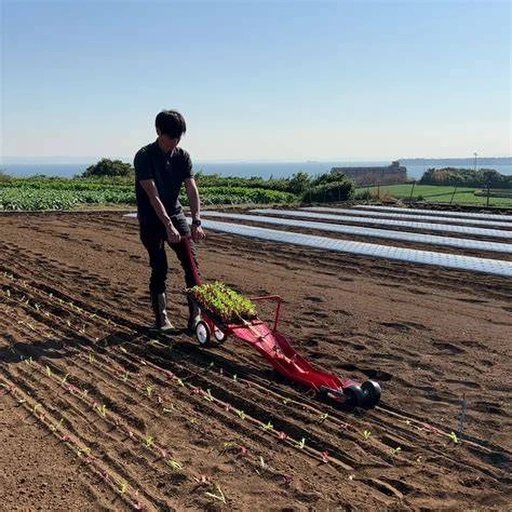
Nitten’s Paperpot range includes paper pots, connected Chainpots, and transplanters. A Chainpot’s connections establish its planting pitch; changing tractor speed does not by itself create variable in-row spacing.
Nitten also describes a TDS-K-0 tractor-mounted unit connecting two transplanting units. This is a technical reference, not proof that the unit directly fits a SiFT Tractor.
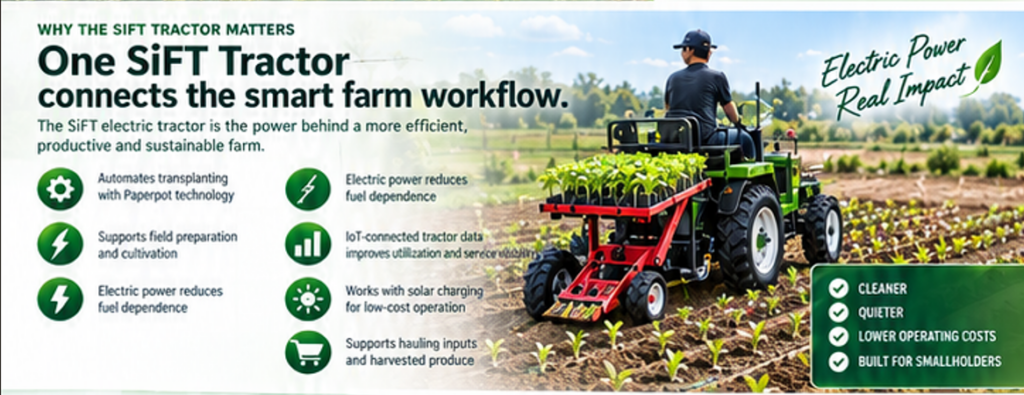
THE PROPOSED SiFT WORKFLOW
Operator-supervised. Measured in the field.
01
Select the crop system
Choose pot size, planting pitch, seedling age, and a crop that suits the selected transplanting setup.
02
Prepare and load
Match bed condition and planting depth. Position trays and define safe replenishment procedures.
03
Set and supervise
Test the adapter, hitch geometry, row alignment, speed, planting depth, and guarding before production use.
04
Inspect and record
Measure missed plants, spacing, depth, establishment, and labour per 1,000 transplants.
IMPORTANT CROP DISTINCTION
Not every transplant belongs in the same chain.
The propagation house can support several vegetable transplant systems. Tomatoes, cucumbers, and bell peppers may require different pot volumes, spacing, handling, or planting equipment from close-spaced Chainpot crops. Do not assume that the same attachment is suitable for all crops.
Automated planting here means proposed mechanized placement within a supervised workflow. Full autonomy, universal crop compatibility, and a validated SiFT attachment are not claimed.
VALIDATION BEFORE DEPLOYMENT
Start with a controlled demonstration plot.
ENGINEERING
Approve the interface
Document loads, adapter strength, pin retention, clearances, stability, and emergency procedures.
AGRONOMY
Approve the crop recipe
Evaluate planting pitch, root-zone condition, seedling readiness, and establishment irrigation.
OPERATIONS
Prove repeatability
Train operators, record interventions, and compare measured results with the reference method.
START A CONVERSATION
Develop a planting workflow that can be demonstrated.
Explore demonstration opportunities, training, technology integration, or a farm model for your community.